Global Career Incubator

GCAP ENTERPRISE

Develop capability where business results are made.

GCAP ENTERPRISE helps managers and emerging leaders strengthen global leadership, hiring and interviewing skills, and performance at work. We combine workshops, individual coaching and workplace assignments, drawing on GCAP career-support programmes, hiring knowledge from major global companies and our consultants’ management and operating experience. Participants apply what they learn to actual business challenges, then review their actions and results with feedback.

Global leadership in practice

For managers and emerging leaders working across locations, languages and cultures, we combine workshops, individual support and workplace practice. Topics can include one-to-one meetings, evaluation conversations, feedback and multinational team management.

From learning to work

Turn development goals into work assignments

Define the goal through the work the participant is expected to do and the result it should support. Drawing on GCAP know-how, hiring knowledge from major global companies and management experience, consultants help clarify the issue, support workplace practice and review what happens.

Move a discussion towards an agreed next action

Rather than aiming only for fluent English, identify whose decision a real meeting needs to move forward, and what that decision is.

01

Choose a real work situation

Start with a task the participant owns, such as a regular meeting with an overseas operation. Clarify the people involved, the agenda, the decision needed and the information available.

02

Define observable actions

Ask about the other person’s concerns, present options and evidence, and confirm responsibilities and deadlines. Choose the behaviours to practise in the context of the work.

03

Practise, then apply it at work

Rehearse the conversation and refine the approach with feedback. Try it in a real meeting and record the response and what was agreed.

04

Review and choose the next change

Look beyond whether the participant spoke fluently: could the other person make a decision, and what questions remained? Compare the participant’s and manager’s observations and choose one action to change.

Case Study · Practise at work, then reflect

An illustrative scenario: a participant can explain a proposal in English, but the meeting does not lead to agreement. This shows an approach to development; it is not a reported client outcome.

Response observed
The other person was more concerned about who would run the operation after implementation than about price.
Action to change next time
Before presenting the proposal, ask who will own the operation and what conditions are needed for a decision.
Evidence to review
Record whether the conditions needed for the next discussion were confirmed in the other person’s own words.
When to rethink the approach
If those conditions remain unclear, review the order of questions and the participant’s knowledge of the work, rather than simply adding more vocabulary practice.

Use hiring knowledge to improve judgment

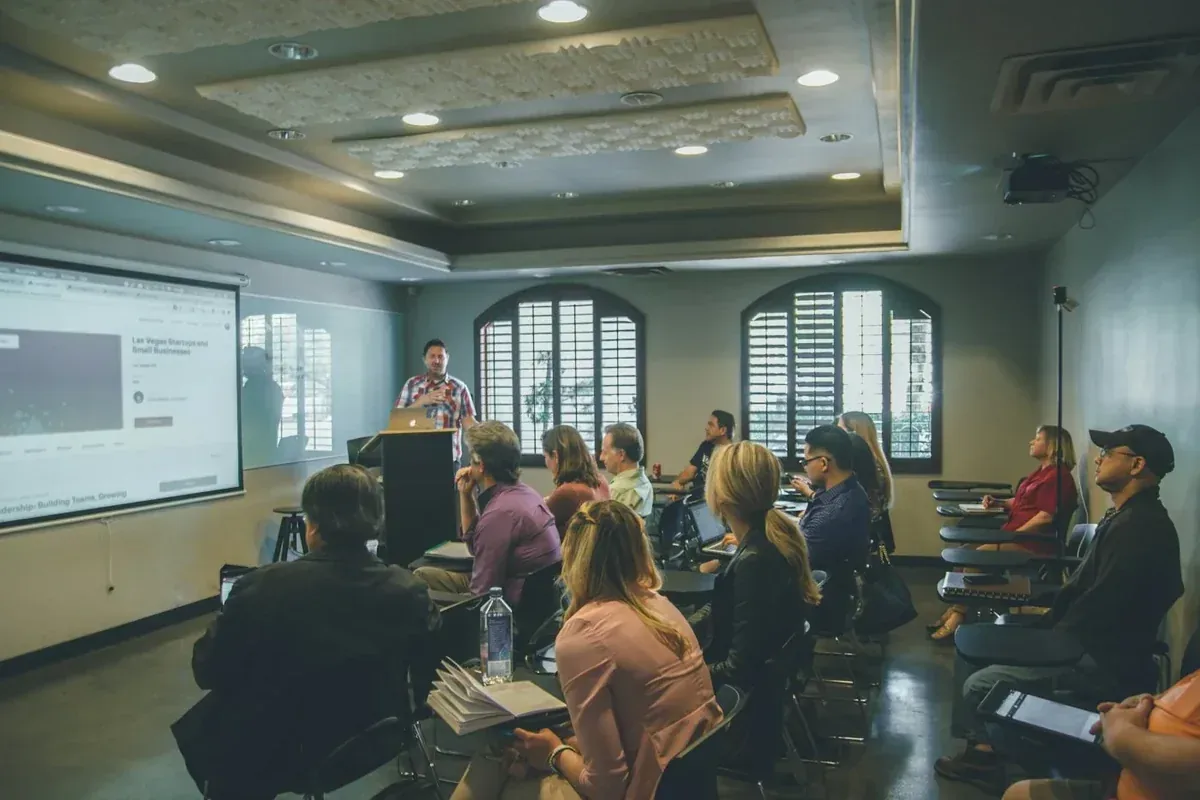
Practical knowledge of interviews and assessment helps managers define what good performance looks like, ask useful questions and examine evidence. Content is adapted to the organization’s roles and evaluation context.

Build capability rather than dependence

The programme can combine group learning, individual coaching, role-play and workplace assignments. We review changes in action and the organization’s ability to continue applying what it has learned. Delivery scope, languages and fees are confirmed for the assignment.

Programme examples

Development shaped around the work and the people

Programmes are designed for your objectives and participants. These are examples of topics we can cover. Duration, group size, delivery format and fees are proposed for the agreed scope.

01

Managers

Practical people management; designing and running one-to-one meetings; performance reviews; harassment prevention in practice; team goals and progress management.

02

Selected emerging leaders

Developing a management perspective; business-planning exercises; decision-making approaches used by major global companies; presentations to senior management.

03

Employees in global roles

Cross-border communication; negotiations and meetings in English; intercultural management; navigating competing expectations between headquarters and local operations.

04

Local managers at overseas operations

Working with Japanese headquarters; aligning expectations; reporting formats. Programmes can be delivered in English.

05

Early- and mid-career employees

Taking ownership of career development; logical thinking and documentation; improving work processes; using AI to increase productivity.

06

Women leaders

Leadership development; planning for career continuity; dialogue with role models.

07

Employees preparing for promotion to management

Understanding management aptitude; aligning expectations before promotion; reviewing the skills required.

OUR PROCESS

How we support development

The approach is tailored to the challenge and agreed scope. Deliverables are examples that can be combined for the engagement; they are not a guaranteed standard package.

01 Define the expected role and challenge
Question to examine
What actions are required in this role?
Example deliverable
Role expectations and assessment criteria.
Decision before moving on
Select the challenge to address through development.
GCI’s role
Clarify the work and expected outcomes using specific situations.
The client’s role
Share the participant’s role and the purpose of development.
02 Review experience, capability and current behaviour
Question to examine
Where is the gap between knowledge and action at work?
Example deliverable
A review of the starting point and priority challenges.
Decision before moving on
Agree the themes to examine through learning and practice.
GCI’s role
Explore experience and current behaviour through dialogue and exercises.
The client’s role
Share opportunities and constraints in the workplace.
03 Plan individual learning and practice
Question to examine
In which situation will the participant try a different approach?
Example deliverable
An individual development plan and practical assignments.
Decision before moving on
Check that the plan can be put into practice at work.
GCI’s role
Combine learning, dialogue and practice in the plan.
The client’s role
Secure opportunities to practise and cooperation from the people involved.
04 Combine workplace practice and feedback
Question to examine
Did the action help the other person make a decision or take action?
Example deliverable
Practice records and reflections.
Decision before moving on
Specify the next action to change.
GCI’s role
Review the practice and provide feedback on the issues and communication.
The client’s role
Try the approach at work and bring back the results and difficult decisions.
05 Review progress and future roles and development
Question to examine
What experience and support are needed next?
Example deliverable
Priorities for further development.
Decision before moving on
Decide whether to continue, change or conclude the support in light of its purpose.
GCI’s role
Clarify the changes achieved and remaining challenges.
The client’s role
Consider assignments, roles and further development.

APPROACH & SCOPE

Support scope and practical questions

Can you deliver programmes in English?

Yes. We also deliver programmes in English for local managers at overseas operations.

What if participants are reluctant to take part?

This is common. At the outset, we take time to connect the reason for participating with the individual’s own challenges. Where needed, we also discuss how to involve their manager.

Who delivers the programme?

The engagement lead is responsible for important judgments and quality checks. We combine practitioners and external specialists according to the expertise required.

Could hiring be more appropriate than development?

Yes. If the diagnostic indicates that hiring or organizational design should take priority over development, we will say so candidly.

Languages & scope

Before we begin

Questions before you start

Planning the programme

Can programmes be delivered online?

Yes. Online and hybrid delivery can support teams spread across locations, including overseas participants. Individual sessions are primarily delivered online.

How many people can take part?

We propose the scope after discussing the participants, their challenges and the delivery format. Group size and duration are designed for each engagement.

Can you work alongside our existing training programmes?

Yes. We can design support to address gaps while avoiding duplication with existing programmes. We can also help review your current training provision.

How can we explain the value internally?

We agree indicators at the start and present the findings in a form that can be used for internal reporting. You can also discuss how the findings might support human capital reporting.

Client examples

Programmes in practice and how we measure change

Client example 01 · IT company (approx. 30 managers)

Measure changes in managers’ behaviour

Set indicators to measure changes in behaviour

For approximately 30 managers, we used one-to-one meeting completion rates and feedback from team members as indicators. The programme was designed to assess changes in day-to-day management, rather than training attendance alone.

Combine group and individual support

We combined group sessions with individual discussions to help participants reflect on how they applied their learning at work. Comparing indicators before and after the programme allowed us to assess whether changes in management behaviour were sustained.

Client example 02 · Financial institution (approx. 15 selected leaders)

Connect selection, development and promotion

Connect selection criteria with development and promotion

For a development programme involving approximately 15 selected leaders, we began by defining the selection criteria. We connected those criteria with the roles and promotion opportunities envisaged for participants.

Build a system for continued use

We develop a pipeline of future leaders and an ongoing approach to selection, development and promotion. The structure is designed for continued use in subsequent years, rather than as a one-year programme.

You can view the table by scrolling horizontally.

Type of indicatorWhat to measure (example)
Behavioural indicatorsOne-to-one meeting completion rates and quality, performance review conversations and team members' feedback (survey)
Organizational indicatorsTarget department engagement, turnover rate, internal promotion rate
Business indicatorsThe relevant team's productivity and target achievement rate, agreed with the business
Changes in participantsDifferences between self-assessment and manager assessment; action-plan completion rate
Our Focus

Three areas of practical development

Global Leadership

Developing globally strong managers and leaders

Managers leading overseas operations or multinational teams need capabilities beyond those developed through work in Japan alone. We combine insights from individual GCAP programmes, hiring knowledge from major global companies and our consultants' management and practical experience, applying them to the work in your organization. Practice, individual support and feedback on workplace challenges help participants change their behaviour and improve business performance.

Practice

Behaviour change at work

Topics include managing team members, one-to-one meetings, performance reviews and harassment prevention. Participants move between role-play and practical application at work.

Individual support

Individual support with workplace challenges

Through individual conversations, we help each participant make specific improvements. We address circumstances that group training cannot cover.

Across cultures

Managing multinational teams

We will cover how to align expectations and evaluation criteria, give feedback based on cultural differences, and manage meetings in English.

Method

Three ways to make development translate into action

Image of the support scene used in the public versionMETHOD 01Practice-centered design
01 — Practice over Theory

Start from practice, not knowledge

We keep theory brief and work with challenges participants face in their own roles. At each session, they define what they will do differently at work and bring the results to the next session.

  • Scenarios based on participants’ own teams and management responsibilities
  • Role-play and feedback
  • Practical tasks and reflections between sessions
Image of the support scene used in the public versionMETHOD 02Individual support alongside group learning
02 — Individual Support

Combine group learning with individual support

Concerns that are difficult to raise in a group can obstruct behaviour change. Individual conversations allow us to address each participant’s circumstances and work towards practical improvements.

  • Individual conversations with each participant at several points during the programme
  • Practical support for managing team members
  • Feedback to the participant’s manager or HR, with the participant’s consent
Image of the support scene used in the public versionMETHOD 03Review progress against agreed indicators
03 — Measure the Change

Measure changes over time

Our work continues beyond satisfaction surveys. At the outset, we agree what should change and how to assess it, then review behaviour and organizational indicators at agreed points. Findings are presented in a format suitable for internal reporting.

  • Behavioural indicators (one-to-one meeting completion rates, quality of performance reviews and team members’ feedback)
  • Organizational indicators (engagement, turnover rate)
  • Before-and-after programme comparison and a summary for internal reporting

Start a conversation

Let’s move forward.

Tell us what you want to change and what is getting in the way. We will clarify the support, responsibilities and next step together.